Amazon has already made half of this decision for you. Its FBA import and export policy↗ states that all shipments to a fulfillment center must use Delivered Duty Paid terms, and that any shipment arriving with collect charges, including duties, taxes or freight, will be refused. If you are shipping to an FC, DAP is not a cheaper option. It is a non-option.
The other half is the part the quote does not show. Three letters on a rate sheet do not tell you whose name is on the customs entry, and in 2026 that name turned into money: refunds on tariffs the Supreme Court voided in February go only to the importer of record, or to a party the importer of record designates. Sellers who bought "DDP" and never saw an entry summary are finding out that the refund was never theirs to claim.
The short answer
| Question | DAP | DDP |
|---|---|---|
| Who clears import customs | Buyer | Seller |
| Who pays duty and import taxes | Buyer | Seller |
| Where risk passes | Named place, on the arriving vehicle, ready for unloading | Same point, but with import cleared |
| Who unloads | Buyer | Buyer |
| Usable for an Amazon FBA shipment | No, Amazon refuses collect-charge deliveries | Yes, and it is the required term |
| Who can claim a duty refund | Buyer, if the buyer is the importer of record | Whoever the entry names, usually the forwarder |
DDP moves the work to the seller, but only the entry moves the rights. You can buy the work and still not own the rights.
Policy source: Amazon Seller Central, "Import and export inventory" (G201468520) and "Delivering imports to Amazon" (G200280280), checked 27 October 2026.
What the two rules actually transfer
Both are Incoterms 2020 rules↗ for any mode of transport, and both sit in group D, which means the seller pays to carry the goods into the destination country rather than just to a ship's rail. That is why they look identical on a rate sheet.
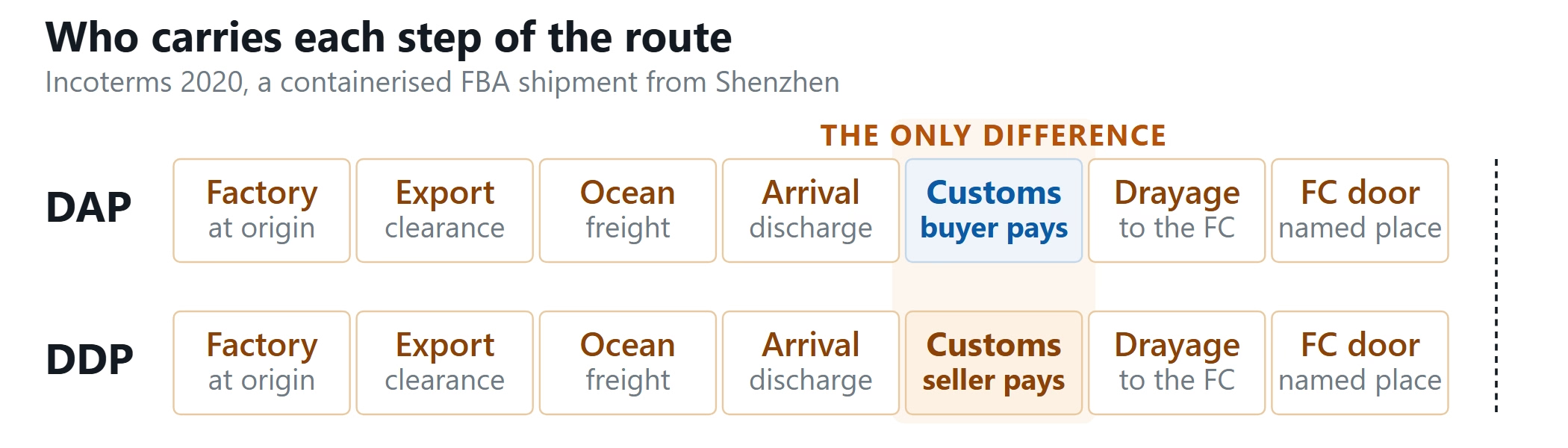
They are identical for most of the journey. Under both, the seller handles export clearance, pays the main carriage, and carries the risk until the goods are placed at the buyer's disposal at the named place, on the arriving means of transport, ready for unloading. At that instant risk passes. The buyer unloads.
The difference is a single step. Under DDP the seller also carries out and pays for import clearance, including duty and any import taxes. Under DAP the buyer does. Everything else in the two sets of rules is boilerplate that happens to be identical. The ICC Academy's side-by-side of DAP and DDP↗ is the quickest way to check that claim against the rule text itself.
Two details worth knowing, because both cause arguments.
Insurance is not required under either rule. Only CIF and CIP oblige the seller to insure. A DDP seller carrying risk all the way to a warehouse in Ohio is doing so uninsured unless the contract says otherwise. Ask for the policy, not the promise.
The named place has to be a real address. "DAP Los Angeles" is not a delivery point, it is a port. Where the named place is the port, the buyer still clears, pays duty and arranges the 60 miles inland. Write the term as DDP plus a full address plus the rule version, or you have written a dispute.
Regulation source: International Chamber of Commerce, Incoterms 2020 rules for DAP (A2, A4, A7, B2, B4) and DDP (A7, A9, B7), cross-checked against the ICC Academy's published comparison of the two rules.
Why DAP stops working at the fulfillment center door
Under DAP the buyer must clear import and pay the duty. When the buyer's delivery address is an Amazon fulfillment center, there is no buyer-side function that can do this. Amazon says so in writing in its guide to delivering imports to Amazon↗: it will not act as importer of record for any FBA shipment, at any size or value, from any origin, and any shipment attempting entry with Amazon as the importer of record will be refused and returned at the shipper's expense.
So a DAP booking runs like this. The container clears the port on a bond that is not yours. The drayage carrier reaches the FC gate. Someone at the gate is asked to accept a delivery with charges outstanding. The FC has no process to pay duty, cannot sign for a customs document, and does not take collect deliveries. The load is refused, and the carrier's next invoice covers returning it plus the days it sat.
The buyer's obligation under DAP has nowhere to land, and the goods are already 6,000 miles from the factory. That is the whole mechanism behind the most expensive sentence in FBA inbound: "DAP is the same thing but cheaper."
If the gate sequence itself is still unfamiliar, the six steps from factory floor to fulfillment center cover the prep, appointment and receiving stages that decide whether a load is accepted at all. The Incoterm decides who pays at the gate; it does not decide whether the gate opens.
A second failure mode hits even sellers who got the term right, and it happens at the consignee field. Amazon will accept being listed as ultimate consignee only where the Amazon entity name is followed by "in care of FBA", and your broker has to obtain Amazon's tax ID before delivery. A blank importer of record on the entry is, in Amazon's wording, grounds for refusal and return.
Policy source: Amazon Seller Central G201468520, "Importer of record" and "Ultimate consignee" sections; Amazon Global Selling manual, "What you need to know for importing and exporting inventory".
The name on the entry: who is the importer of record
The importer of record is the entity CBP holds responsible for the entry. It files or authorises the entry, posts the bond, owes the duty, and answers a document request or an audit. On a DDP shipment the seller is the party clearing, so the seller, or the seller's agent, generally appears there. When the "seller" is your factory in Shenzhen and the "DDP" is a forwarder's all-in rate, the name on the entry is usually the forwarder's US entity or a third-party importer that has nothing to do with your goods.
Most sellers never see that name. It is on the CBP Form 7501 entry summary, which nobody forwards to China by default.
For years this was an administrative detail. In 2026 it became a P&L item.
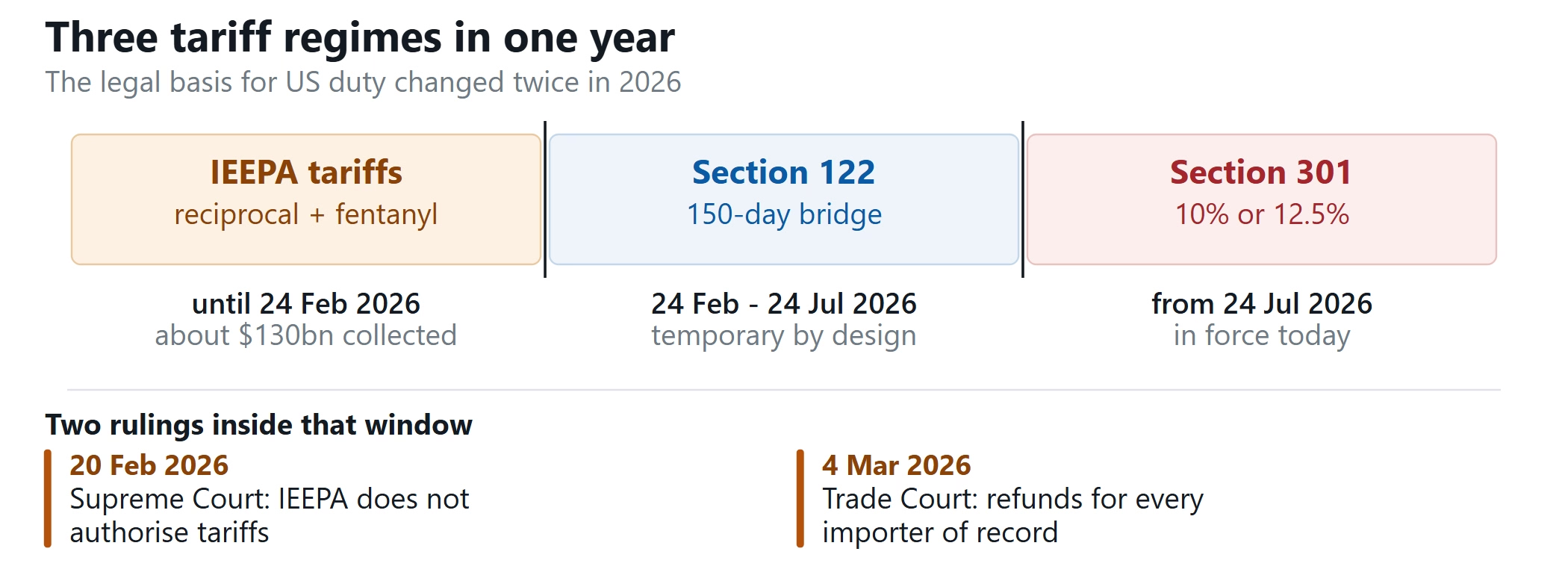
On 20 February 2026 the Supreme Court held in Learning Resources, Inc. v. Trump that IEEPA does not authorise tariffs, and the duties imposed under it, including the reciprocal and fentanyl tariffs, terminated on 24 February. On 4 March 2026 the Court of International Trade↗ ordered CBP to liquidate and reliquidate affected entries without regard to those duties, and held that all importers of record whose entries were subject to them are entitled to the benefit, whether or not they sued. More than $130bn had been collected by the end of 2025, and refund exposure was estimated at around $175bn.
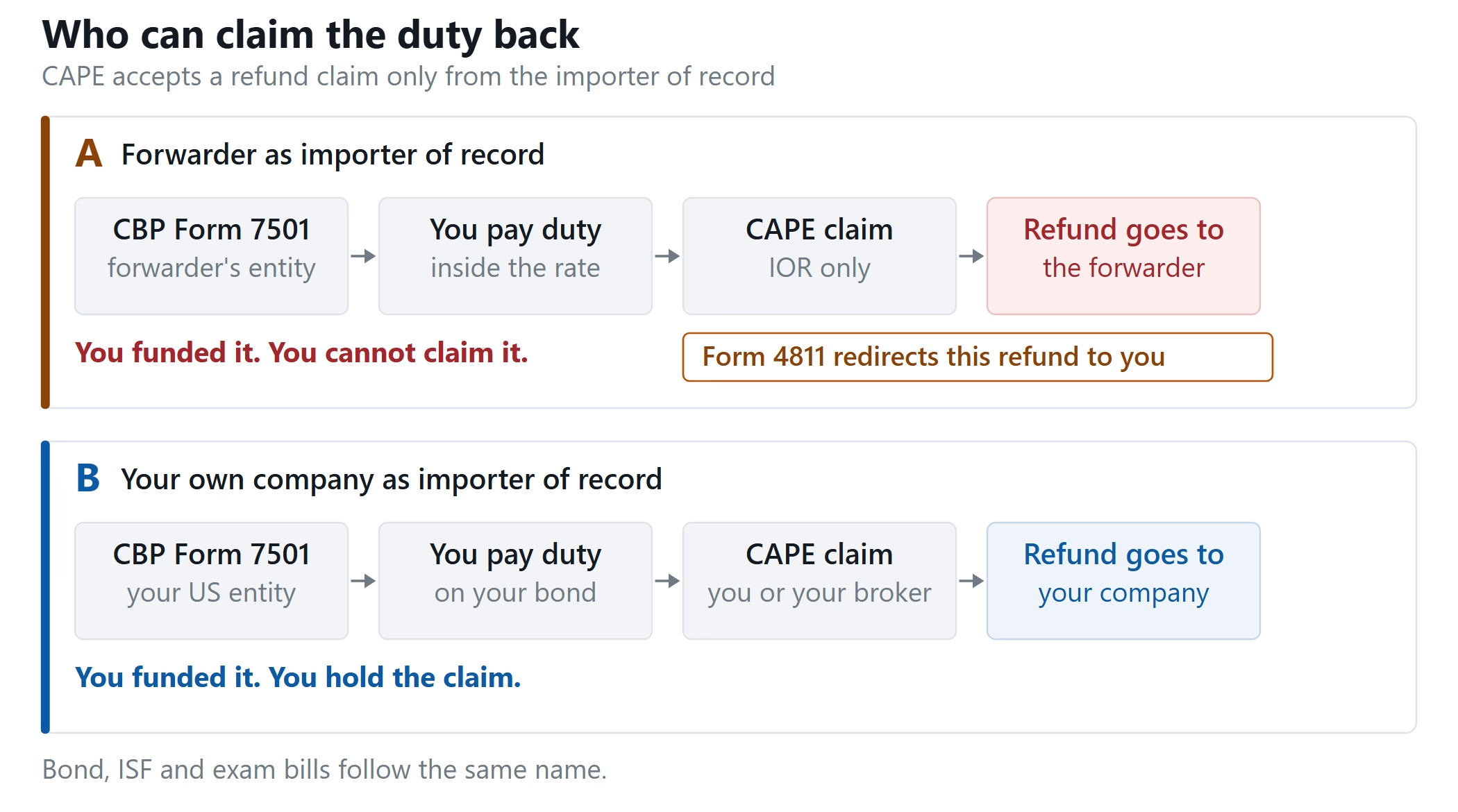
CBP now processes refunds through CAPE declarations filed in ACE, under the rules on its IEEPA duty refund programme page↗. Only the importer of record for those entries, or the customs broker that filed on its behalf, may submit one. Refunds are consolidated by importer of record, or by the party the importer of record has designated on CBP Form 4811, generally within 60 to 90 days of acceptance.
Read that mechanism against the first three sentences of this section. If your forwarder was the importer of record, the refund is the forwarder's to claim. You paid the duty inside a per-kilo rate, and you hold no right to recover it. The only way to pre-empt that is Form 4811, filed before the refund is processed, naming you as the party to receive it.
Regulation source: CBP, "IEEPA Duty Refunds" programme page (CAPE filing rules and Form 4811 designation), checked 27 October 2026. Court order analysis per Krieg DeVault, "U.S. Trade Court Orders Refunds of Unlawfully Collected IEEPA Tariffs", 6 March 2026.
Three questions to put in writing before you book any DDP rate:
- Whose importer number appears on the entry summary for my shipment?
- Will you send me the CBP Form 7501 within ten days of clearance, for every shipment?
- Will you file Form 4811 naming my company as the refund recipient on entries where you are the importer of record?
A forwarder who answers all three is selling DDP. One who answers none is selling a price.
DDP vs DAP, obligation by obligation
The generic comparison tables stop at "who pays duty". These are the rows that decide an FBA shipment.
| Step | DAP | DDP | Why it matters to an FBA seller |
|---|---|---|---|
| Export clearance | Seller | Seller | Identical; not a differentiator |
| Ocean or air freight | Seller | Seller | Identical |
| ISF filing (US ocean) | Buyer's broker | Seller's broker | A missed ISF is a $5,000-plus penalty per violation, charged to the importer |
| Customs bond | Buyer | Seller or its agent | You cannot buy a bond without a US entity or a surety willing to write one |
| Entry filing and duty | Buyer | Seller | The line that changes the price |
| MPF and HMF | Buyer | Seller | 0.3464% and 0.125% of value; small, but they are inside a real DDP rate |
| Customs exam costs | Buyer | Seller | Exams are billed to the importer; under DAP that is you, remotely |
| Delivery to the FC | Seller to named place | Seller to named place | Same, and this is where the named place must be the FC address |
| Amazon appointment | Whoever books the drayage | Usually the forwarder's US arm | Missed appointments are the most common cause of a refused load |
| Refused or returned load | Buyer's problem in theory | Seller's problem in practice | Amazon returns at the shipper's expense either way |
| Duty refund rights | Buyer, as importer | The named importer, usually not you | The 2026 issue |
| Unloading at the FC | Buyer | Buyer | In practice Amazon unloads; do not build a cost model on the reverse |
Fee source: CBP, Importer Security Filing at 19 CFR 149.2 (liquidated damages of $5,000 per violation for a missed or late filing); merchandise processing fee at 19 CFR 24.23, 0.3464% ad valorem with a fiscal year 2026 floor of $33.58 and ceiling of $651.50 per entry; harbour maintenance fee at 19 CFR 24.24, 0.125% of cargo value.
What a DDP quote is really made of
A DDP rate is not a shipping rate with duty added. It is a bet on your declared value, your HS code and the duty rate at the time of entry. Run the arithmetic yourself once and the quotes stop being opaque.
The freight line is the only one that moves month to month; the lane rates for ocean, LCL and air are tracked separately, and a forwarder quoting a per-kilo rate well below both is not quoting a market price.
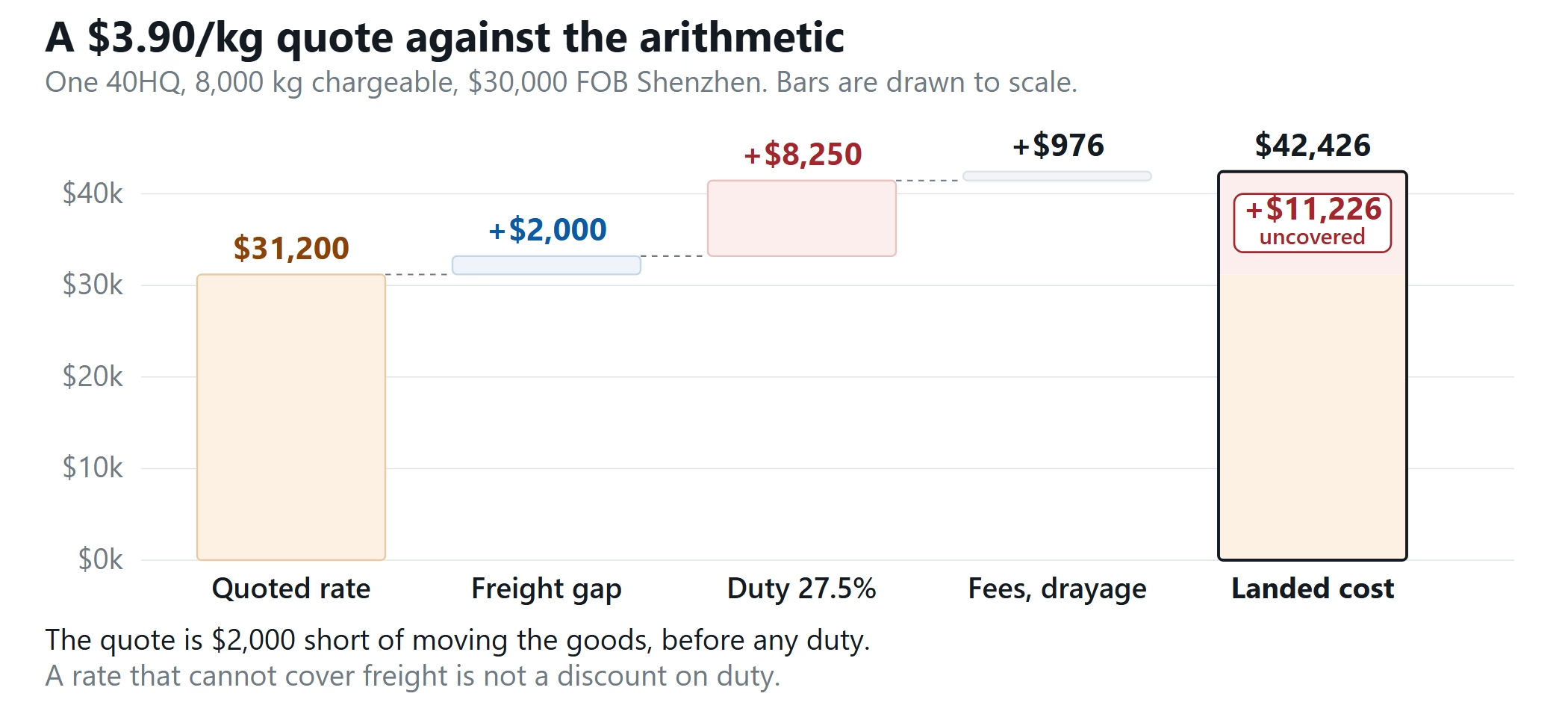
Worked example, one 40HQ, 400 cartons, 8,000 kg chargeable, 18 CBM, goods value $30,000 FOB Shenzhen:
| Line | Amount | Note |
|---|---|---|
| Goods, FOB | $30,000 | Transaction value |
| Ocean freight | $3,200 | Assumed |
| Duty, 27.5% | $8,250 | Rate is an assumption; your HS code sets it |
| MPF, 0.3464% | $103.92 | Floored and capped annually by CBP |
| HMF, 0.125% | $37.50 | Ocean cargo only |
| Broker fee and ISF | $185 | Assumed |
| Drayage, port to FC | $650 | Assumed |
| Landed, DDP-equivalent | $42,426 |
Two things fall out of that table.
US duty is assessed on the FOB value, not the delivered value. International freight is excluded from the US customs value, unlike the CIF basis used in the EU. A forwarder who charges duty on goods plus freight is overcharging you by the duty rate times the freight.
Any DDP rate below the arithmetic is a declaration problem, not a discount. At 8,000 kg, the landed cost above is $5.30/kg. A quote of $3.90/kg is $31,200 for goods worth $30,000 that also cost $3,200 to move. There is no duty in that number because the declared value is not your invoice. You meet the bill later, as a CBP penalty assessment against the importer of record, a seizure, or an Amazon account review, and the entry carrying the problem has someone else's name on it.
Below a full container the same charges arrive per shipment rather than per box. Six point four cubic metres of LCL from Ningbo to a warehouse in City of Industry cost $2,332 to move and clear and $9,082 delivered, and the nine handoffs in that chain touch the same entry, the same duty and the same importer of record.
Three signals that a cheap DDP is thin.
- The per-kilo rate did not move in July 2026. The IEEPA tariffs ended on 24 February, a temporary Section 122 surcharge ran until 24 July, and new Section 301 duties↗ of 10% or 12.5% took effect on 24 July. A sheet identical across those three regimes is not tracking duty.
- No HS code and no declared-value basis in the quote. A DDP price without both is an estimate dressed as a rate.
- No entry summary, ever. The 7501 is the only document that proves what was declared and what was paid.
Regulation source: USTR, Section 301 determination published 23 July 2026, additional duties applicable to entries on or after 24 July 2026; Section 122 surcharge expired the same day. Duty rates quoted above are illustrative and must be checked against the current HTSUS for your HS code at the time of entry.
When DAP is the better answer
DAP is a worse term for FBA, not a worse term. It wins in four situations.
You have a US entity with an EIN and a continuous bond. Then you can be the importer of record yourself, you control the declared value, you hold the refund rights, and you see every 7501. The freight saving is real, because you are no longer paying a forwarder to price customs risk for you.
The goods do not go to an Amazon FC. A 3PL, your own warehouse, a customer's dock: all of these work under DAP. The term only breaks where the buyer has no customs function.
You are selling to a US distributor who is the importer. Then DAP is correct and DDP would make you the importer for goods you never own commercially.
You are moving goods into the EU and have an EU establishment. Amazon will not act as declarant for FBA inventory into the EU, and a seller established outside the EU must clear through a representative established in the EU. If you have that establishment, DAP lets you recover import VAT through your own return. If you do not, "DDP including VAT" is a promise someone else is keeping on your behalf, and the VAT is a permanent cost rather than a credit.
Policy source: Amazon Global Selling manual, EU import section: Amazon will not serve as declarant or consignee for FBA inventory into the EU.
Three mistakes and what each one costs
Mistake 1: Choosing DAP to save a few cents a kilo
The quote says DAP, DDU or "duty collect", and the rate is 0.2 to 0.4 dollars per kilo under the DDP option. The load is then refused at the FC gate: Amazon returns it at the shipper's expense, you pay the return leg and the storage days, and the replacement shipment misses its appointment window. Read the Incoterm before the rate. If it is not DDP, the number is not comparable.
Mistake 2: Letting the forwarder be the importer of record without a paper trail
You have shipped for a year and have never seen a CBP Form 7501. That means duty refunds, protest rights and penalty exposure all sit with a company you did not choose. The 2026 IEEPA refunds are the clearest example and will not be the last. Require the 7501 within ten days of clearance, and file Form 4811 wherever the forwarder is the importer. Both are routine requests to a real forwarder.
Mistake 3: Treating a DDP price as fixed while the tariff changes underneath it
Your per-kilo rate did not change between June and August 2026. If the duty rate rose and your price did not, the difference came out of declared value, and liability for a materially false entry sits with the importer of record under 19 U.S.C. 1592. Ask for the duty rate and the declared value basis in writing on every quote, then compare quotes on landed cost rather than per-kilo rate.
FAQ
Is DDP always more expensive than DAP?
Usually on the invoice, not always in total. DAP moves duty, broker fees, bond cost and exam risk to you, and those arrive later, often as separate invoices from companies you have not chosen. Compare landed cost, not rate.
Can I use DAP for an FBA shipment if I nominate Amazon as consignee?
No. Amazon will not act as importer of record for any FBA shipment, and shipments arriving with collect charges are refused. Being listed as ultimate consignee "in care of FBA" does not change who clears the goods.
Who pays customs duty under DDP?
The seller, and in practice the forwarder selling you the DDP rate is the party named on the entry. The cost sits inside your price, which is not the same as you holding the right to claim it back.
Does DDP mean I have no customs risk?
It means you have no customs work. Liability for an inaccurate declaration stays with whoever is named as importer of record, and Amazon still holds you responsible for the accuracy of your own shipment data.
Is the $800 de minimis still available?
No. Duty-free de minimis was suspended for China and Hong Kong on 2 May 2025 and for all countries on 29 August 2025, and CBP's low-value shipment processing rules↗ suspended it indefinitely on 24 June 2026. All shipments valued at $2,500 or less now pay applicable duties, except genuine gifts of $100 or less.
Does a DDP price include EU VAT?
Often it includes the cash, rarely the right to reclaim it. Import VAT is recoverable only through a VAT registration in the member state of import. Where a quote includes VAT and you hold no registration, that VAT is a permanent cost.
Date source: CBP national media release on low-value shipment processing and the interim final rules of 24 June 2026; Executive Order 14324 of 30 July 2025; statutory repeal date of 1 July 2027 as reported by the Fashion Law Journal.
Sources
| Document | Issued by | Reference |
|---|---|---|
| Import and export inventory↗ | Amazon Seller Central | G201468520 |
| Delivering imports to Amazon↗ | Amazon Seller Central | G200280280 |
| Incoterms 2020 rules↗ | International Chamber of Commerce | ICC publication 723E |
| DAP and DDP compared↗ | ICC Academy | — |
| IEEPA duty refunds↗ | U.S. Customs and Border Protection | CAPE / Form 4811 |
| Low-value shipment processing↗ | U.S. Customs and Border Protection | August 2025 release |
| Section 301 determination, 60 economies↗ | Office of the U.S. Trade Representative | Federal Register, 23 July 2026 |
| CIT order on IEEPA refunds↗ | National Law Review | 5 March 2026 |
Rates, fees and duty figures here were checked on 27 October 2026. Tariff treatment changed three times between February and July 2026. Confirm the current HTSUS rate for your HS code at the time of entry, and treat any figure on this page older than the date above as history rather than quotation.
Written by the logistics editorial team. Reviewed 27 October 2026.