Shipping from a Chinese factory into Amazon FBA takes 32 to 48 days by ocean and 12 to 24 by air, measured door to available. Freight is the smallest part of that clock. Factory prep, the customs entry, the delivery appointment and the receiving scan eat the rest, and any one of the four can send the cartons back.
If you have not decided whether to ship straight into FBA at all, the first section answers that with a table.
Can you ship from China to Amazon FBA without a 3PL?
Yes. Nothing in Amazon's policy stops a Chinese factory from loading cartons that go directly to an FC. Two conditions decide whether it is a good idea.
The first is customs. Amazon will not act as your importer of record. Someone on your side has to file the entry and pay the duty before the truck reaches the dock. Direct-to-FBA adds no customs work, but it removes the warehouse where you could have fixed a paperwork problem.
The second is timing. Direct-to-FBA gives you one chance to get the cartons right. There is no point in the route where somebody opens the box and checks.
| Route | Best for | What it adds | What it costs you |
|---|---|---|---|
| Factory to FC, direct | Replenishment of 1 to 3 proven SKUs | Nothing | Any defect goes to the dock unreviewed |
| Factory to 3PL, then FC | First shipments, bundles, relabels, peak stock | A receiving scan, storage, a second pickup | 5 to 9 days and roughly $0.35 to $0.90 per unit |
| Factory to AWD | Bulk stock you will release in waves | Amazon-managed storage, pallet-only intake | You still pay to move units from AWD to FBA |
AWD, for the third row, is Amazon Warehousing and Distribution: bulk storage upstream of the fulfillment centers, pallets rather than parcel, and a separate charge to move units into FBA.
Direct-to-FBA gets cheaper as order size grows, because the fixed cost of an entry, a drayage move and an appointment booking spreads across more units. At 200 units it is a bad deal. At 2,000 it usually wins.
Go the buffer route in three cases. It is your first shipment from this factory, so you have never seen their cartons. The order needs bundling or relabeling, which Amazon will not do. Or you are building peak-season stock and want it stored somewhere that does not charge October rates.
Which products should not go direct at all
Order size decides the route. Product type can override it, and five categories break the direct route for reasons that have nothing to do with freight.
| Product type | Why the direct route fails | What to do instead |
|---|---|---|
| Lithium cells, power banks, anything with a built-in battery | Amazon runs a dangerous goods review before the SKU can ship to FBA at all. It asks for a safety data sheet and a UN 38.3 test summary, and the classification takes two business days | Get both documents from the factory before the purchase order. Submit the review while the goods are still in production |
| Aerosols, alcohol-based liquids, flammable cosmetics | Same review, plus a containment layer on every unit and hazard class markings on the outer carton | Ask the prep center whether they accept your hazard class. Many decline it outright |
| Meltables: chocolate, gummies, some balms | Amazon takes meltable stock only between 28 September and 20 April. Anything arriving in the closed window is marked unsellable and disposed of | Book the vessel so the container lands after 28 September, or sell that SKU merchant-fulfilled through the summer |
| Children's products, wireless electronics, food, anything that touches skin | US law wants a document before the goods can enter: a Children's Product Certificate, an FCC equipment authorisation, an FDA prior notice. Amazon asks at listing stage, customs asks at the port | Treat the certificate as a production item, not a shipping item. If the factory cannot produce it, the product is not ready to ship |
| Single units over 50 lb or over 36 in | They cannot go into a standard carton, and oversize intake is limited to certain fulfillment centers | Confirm the assigned center takes oversize before you build the pallet |
Data source: Amazon Seller Central help pages G202125070 (meltable inventory) and 201371860 (dangerous goods), checked 22 October 2026.
If your product is in the first two rows, the shipment is not a freight problem and no forwarder can fix it. Get the classification cleared while the goods are still on the line, because a hazmat review that starts after the container is booked will miss the vessel.
Step 1: Get the cartons FBA-ready inside the factory
Since 1 January 2026, Amazon no longer preps or labels FBA inventory↗ in the United States. The work now belongs to the factory or a third-party prep center. That single change moved the riskiest part of the shipment upstream, to a place where nobody from your company is standing.
Shipments created before that date still received prep. Shipments created after it, arriving unprepared, are not reimbursed for the damage that follows.
Policy source: Amazon Seller Central help page G201023020, the prep and labeling service that ended 1 January 2026, checked 22 October 2026.
What Amazon requires on every unit
An FNSKU is the barcode Amazon issues for your specific offer, not the manufacturer's UPC and not the ASIN. The receiving scanner reads that code and nothing else, so which face of the package it sits on decides whether the unit scans at all.
| Requirement | Standard | Common failure |
|---|---|---|
| Item label | FNSKU on a flat surface, scannable, no overlap or wrinkle | Label wrapped around a curve, or placed over a seam |
| Poly bag | Suffocation warning if opening is 5 in or wider, bag must not be loose | Bag taped but unlabeled, bag slides off in transit |
| Bundle | Sold as one unit, so it must arrive as one unit with one FNSKU | Two FNSKUs on a shrink-wrapped pair |
| Expiry | Expiration date printed on the unit and on the carton | Six months of shelf life left at check-in |
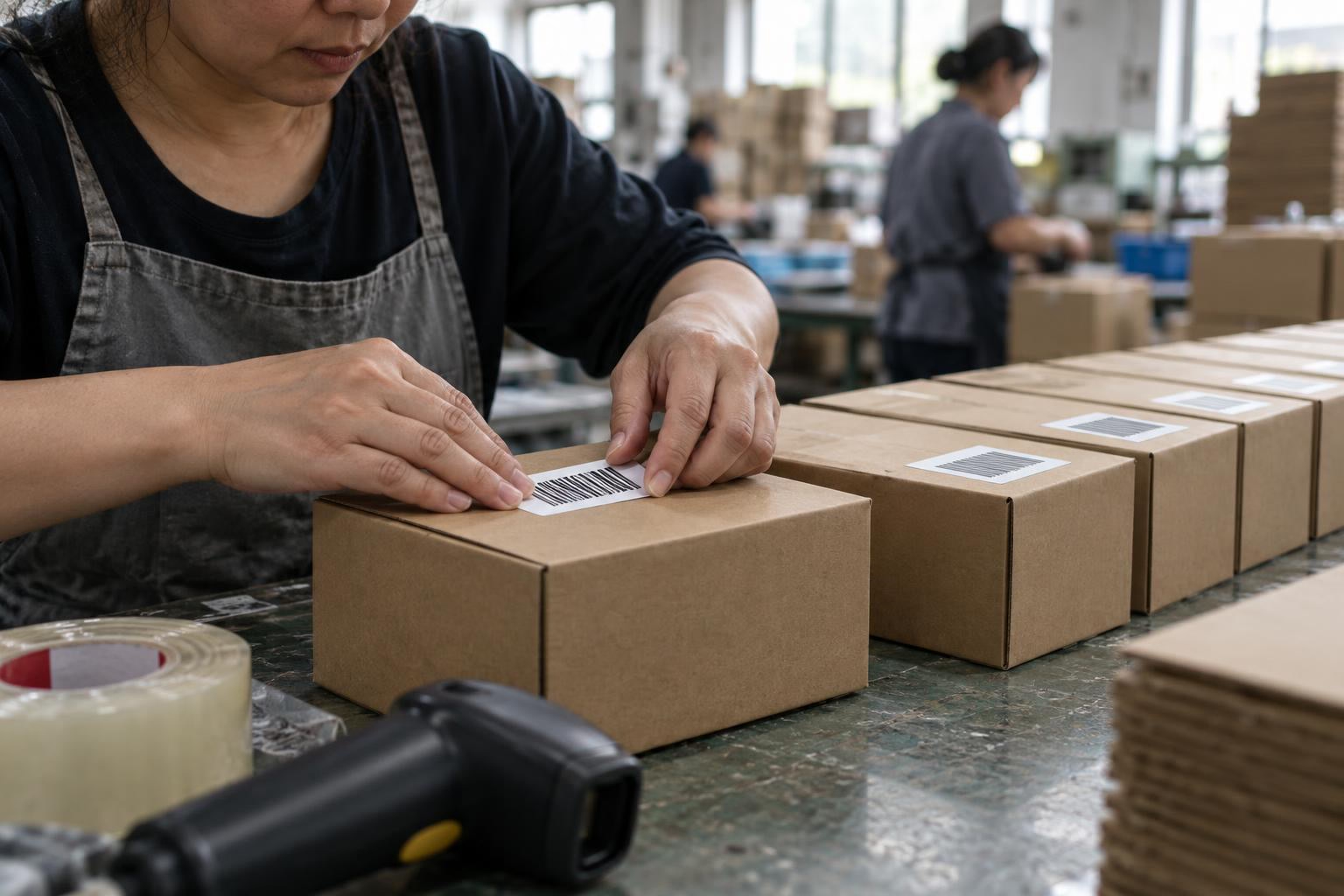
What Amazon requires on every carton
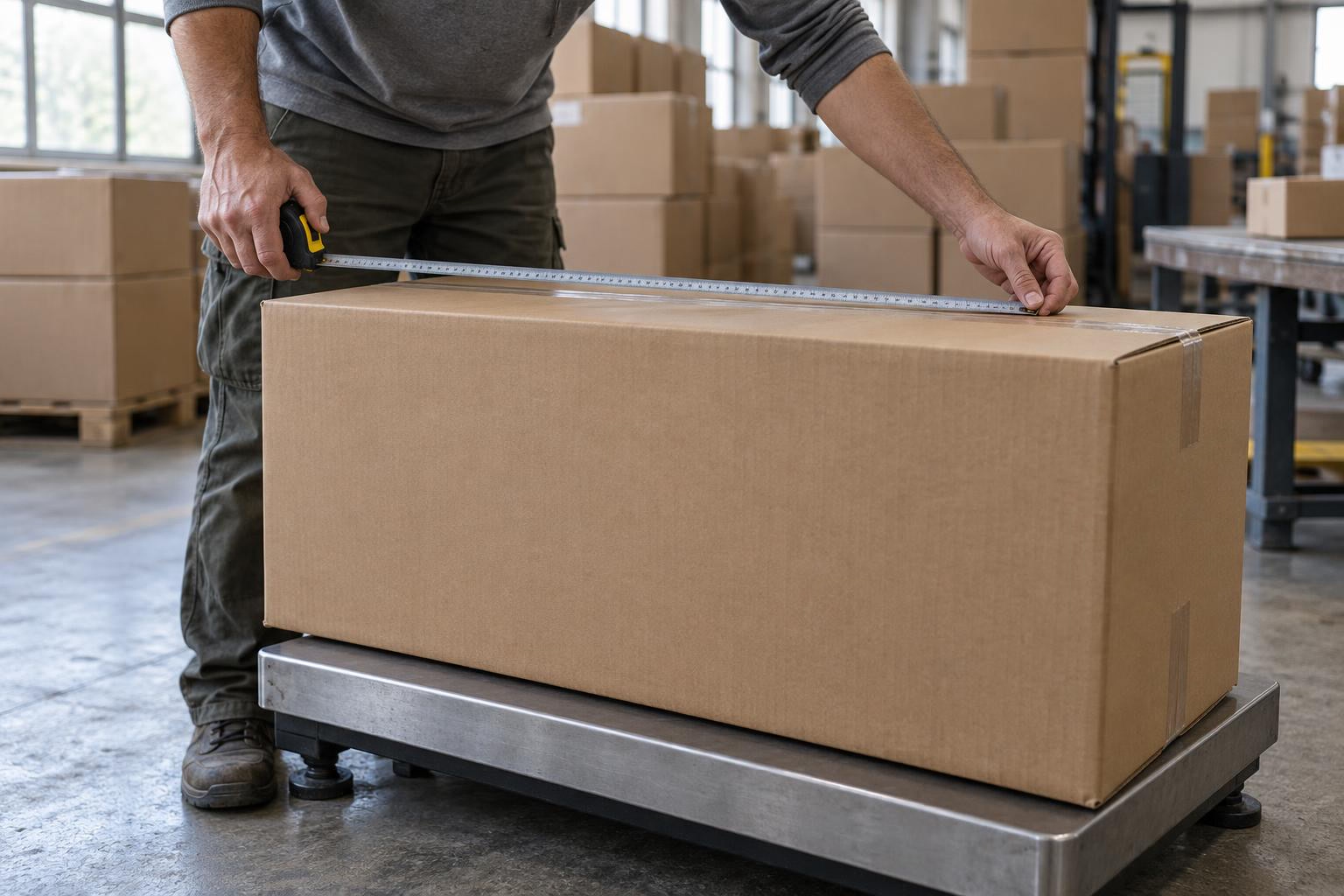
Amazon's current limits are 36 by 25 by 25 inches and 50 lb, with a floor of 6 by 4 by 1 inches, per the FBA shipment requirements↗. The 36 inch length limit replaced the old 25 inch rule on 20 June 2025, and a lot of prep checklists on the internet still print the old number. AWD still caps at 25 inches on every side, so a carton built for AWD may fail at FBA and the reverse is not true.
Specification source: Amazon Seller Central help page G200141510, including the 20 June 2025 carton size change, checked 22 October 2026.
The instruction sheet to send with the purchase order
Send this before production ends, not when the truck is already waiting.
- Carton count and the exact unit count per carton, in writing.
- Carton dimensions and gross weight, per carton.
- The FNSKU placement rule as a photo of one correctly labeled unit.
- Poly bag spec, including the suffocation warning text if it applies.
- Which cartons are bundled, and how the bundle is sealed.
- A request for photos of every carton face before sealing, and of the sealed pallet.
A factory that has shipped to Walmart or Target will usually get this right on the first try. A factory that has only shipped to trading companies will not, and the gap shows up as a rejection notice three weeks later.
What goes wrong here
None of the three below is a customs problem. All three are decided in the factory, and each one has a cost you can put a number on before it happens.
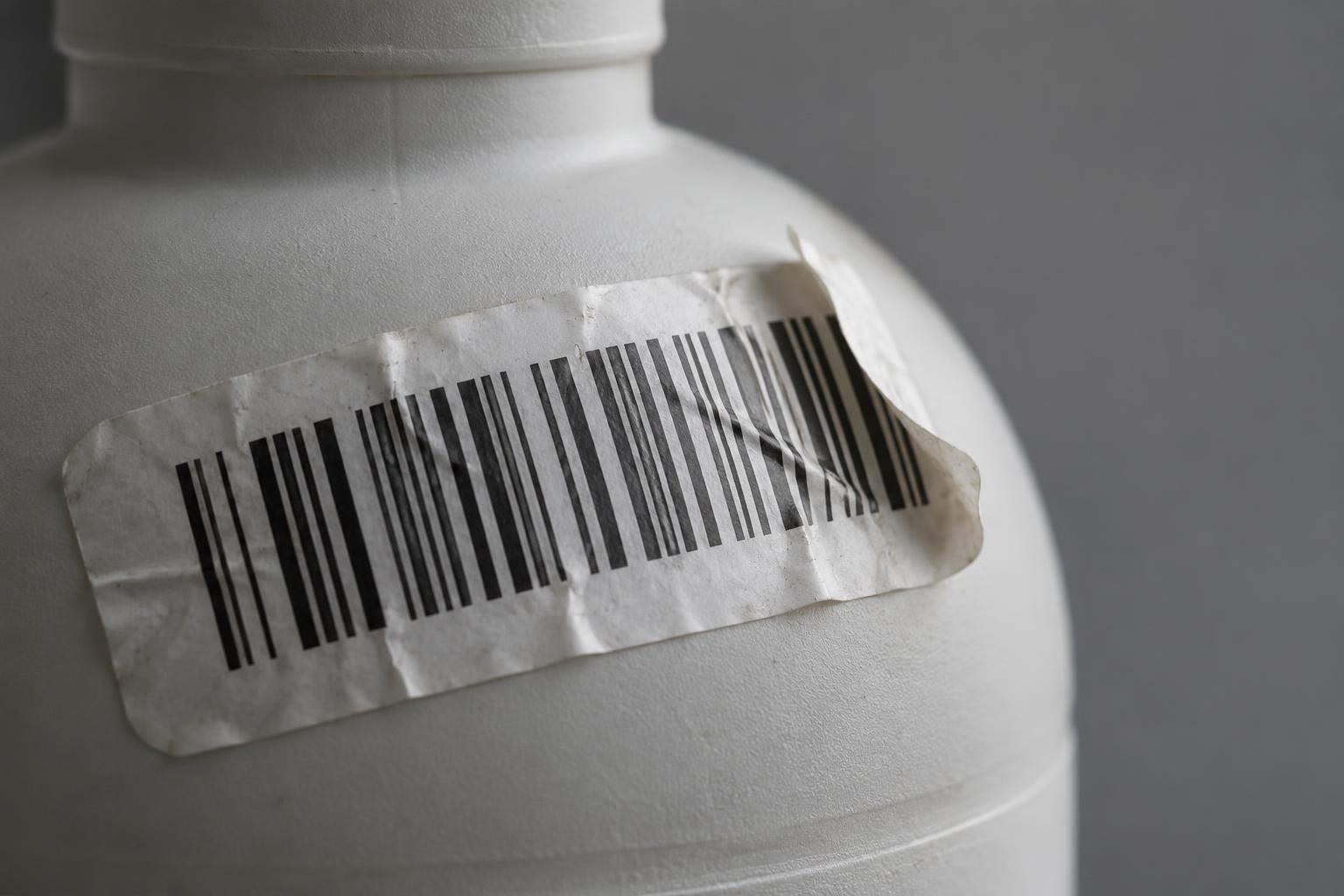
The label that scans on the bench
A label wrapped around a curved bottle, or laid across a seam, reads fine under a desk lamp and fails on the conveyor. The scanner rejects the unit, the carton goes to the problem pile, and you find out weeks later when the shipment closes short.
Budget $0.50 to $1.00 a unit for a relabel at a prep center near the port, plus about a week. A refusal adds the freight in both directions on top of that.
Ask the factory for a five second video of a warehouse scanner reading the label at arm's length, on the finished package. A close up photo of a paper printout proves nothing.
The carton that gains weight at sea
Kraft board takes on moisture across four weeks in a container. A carton that leaves at 49 lb can cross 50 lb by the time it reaches the fulfillment center, and the limit is checked on their scale, not yours. Dimensions move the same way, which is how a carton measured at 35 inches in the factory arrives over 36.
The cheap outcome is rework at a 3PL near the port and a second appointment. The expensive one is a return to origin.
Spec the carton to 47 lb and 35 inches, and leave the margin on the China side of the water.
The mixed carton nobody planned
A factory packs two SKUs into one carton to land on a round carton count. The shipment plan says one SKU per carton. The receiving scan attributes both units to whichever code it reads first, and the second SKU later shows as short.
That becomes a reconciliation case with a deadline. A mixed carton can also drop you below the five identical carton threshold, which turns a zero placement fee into a charge on every unit in the shipment.
Write the SKU count per carton into the purchase order, and check it against the packing list before you generate box labels. A mixed carton is cheap to fix while the cartons are still open.
All three are cheaper to fix in China than in Ontario, California.
Step 2: Inspect the load before the truck leaves
A pre-shipment inspection covers two different questions. Quality inspection asks whether the product works. FBA readiness asks whether the cartons will be accepted. Order the second one by name, or you will get a quality report with nothing in it about labels, weights or carton counts.
Ask the inspector for these ten items in the report, with photos attached to each.
| Check | Pass condition |
|---|---|
| Unit count | Matches the packing list, counted by carton, not by pallet |
| FNSKU scan | Scans at arm's length under warehouse lighting |
| Label placement | Flat surface, no seam, no bubble under the label |
| Poly bag | Sealed, warning printed, no loose fit |
| Carton weight | Under 50 lb on a calibrated scale, sampled at both ends of the run |
| Carton size | Longest side under 36 in, measured on three cartons |
| Carton markings | FBA box ID label readable, no old label underneath |
| Mixed cartons | None, unless the shipment plan says otherwise |
| Pallet build | Cartons flush to the edge, no overhang, height under 72 in |
| Damage check | No crushed corners from the last internal move |
Do not accept a report that lists the ten items without photos. The photo of a correctly labeled unit is the only artifact your prep center, your forwarder and Amazon will all read the same way.
Step 3: Choose how it moves
Four modes cover almost every China-to-FBA shipment. The choice is driven by your inventory runway, not by the rate per kilo.
Three terms do most of the work in that table. LCL means less than container load, so your cartons share a container with other shippers and you pay by the cubic metre. FCL means you buy the whole container, so the rate is per box no matter how full it is. Drayage is the short truck move from the port to a warehouse or rail ramp, billed per container rather than per kilo.
| Mode | Door to FC | Usual load | Rate range, Q4 2026 | Use it when |
|---|---|---|---|---|
| Express courier | 3 to 7 days | Under 100 kg | $7 to $11 per kg | Launch stock, a stock-out, samples that must arrive this week |
| Air freight | 8 to 14 days | 100 kg to 1,000 kg | $4.50 to $6.50 per kg | Replenishment you missed the ocean window for |
| Ocean LCL | 30 to 42 days | 1 to 14 CBM | $85 to $140 per CBM plus destination | Under 15 CBM, planned replenishment |
| Ocean FCL | 25 to 38 days plus rail or truck | 15 CBM and up | Low to mid $2,000s for a 20ft to the West Coast | Full container of one or two SKUs |
Every number in that table is a range we see in quotes this quarter, not a rate card. Rates move monthly and the spread between the cheapest and the most expensive forwarder on the same lane is often 40 percent.
Two things decide more than the mode itself. Port choice sets the inland leg, and the inland leg sets the appointment risk. Los Angeles and Long Beach give you cheap drayage and the worst appointment queues. Savannah and Norfolk give you a longer ocean leg and a calmer dock.
Air freight only pays when the margin on the units covers the difference. Run the number. If ocean costs $0.40 per unit and air costs $2.10, air has to earn back $1.70 per unit in sales you would otherwise lose. For a product selling at $35 with a 30 percent margin, that is a five week gap in stock, which is usually the real comparison.
Step 4: Clear US customs as the importer of record
Amazon is never your importer of record. A shipment with no valid IOR sits at the port while three parties argue about who was supposed to file, and the storage clock runs the whole time.
Who files, and in what order
The importer of record is the party legally responsible for the entry. In plain terms, it is the company whose name goes on the customs form, and the one CBP will bill, fine, or audit. It can be your US entity, a foreign entity in some cases, or a party you appoint. Whoever it is needs three things ready before the vessel arrives.
A customs bond, either single entry or continuous. A bond is the guarantee CBP draws on when a duty bill goes unpaid, and the entry is not accepted without one. Most sellers moving more than two or three shipments a year buy a continuous bond, because a single entry bond costs almost as much per shipment and has to be arranged every time.
A broker with a power of attorney on file. The POA is the one page that lets the broker file under your name, and it has to be signed before the broker can file. Brokers will not chase you for it at 6 pm on a Friday.
An entry with a classification you can defend. That means an HTS code matched to the actual product. The HTS code is the ten digit line in the Harmonized Tariff Schedule that sets the duty rate, and it is the first number a customs officer will question.
Entry summary is due within 10 calendar days of the merchandise arriving at the port of entry, per CBP's guidance on filing a formal entry↗. Miss it and the penalties run against the importer, not the forwarder.
Regulation source: US Customs and Border Protection guidance article 1073, checked 22 October 2026.

Why one tariff percentage is always wrong
Duty on a Chinese-origin product is a stack, and the stack changes by HTS code. Start with the base rate for the code, then check whether the code sits on a Section 301 list, then check any additional action that applies to the country of origin.
The practical consequence is that two products in the same container can carry sharply different rates. Sellers who budget a flat 25 percent across a mixed container are usually over-reserving on some lines and badly under-reserving on others. Get the HTS codes from your supplier in writing, verify them against the USITC tariff database, and have the broker confirm the stack before you approve a purchase order.
De minimis is gone, which removed the last route around this. The $800 threshold ended for China and Hong Kong on 2 May 2025 and was suspended globally on 29 August 2025, as CBP confirmed in its collection announcement↗. Every commercial shipment now needs a formal or informal entry and pays duty.
Date source: CBP newsroom release on de minimis collection, checked 22 October 2026.
DDP or DAP
| Term | Who clears customs | Who pays duty | What to watch |
|---|---|---|---|
| DDP | The forwarder, as the importer of record or through a named IOR | The forwarder, bundled into the rate | You may lose the right to claim duty drawbacks, and the rate hides the duty |
| DAP | You, or a broker you appoint | You, billed directly by CBP | You need a bond and a broker before the vessel lands |
DDP is not mandatory, whatever the sales page says. It is convenient, and for a first shipment it removes a week of setup. But a DDP quote that is 15 percent below the market is not buying you efficiency. It is usually under-declaring the value, and the liability for that lands on the importer of record, which in a DDP deal may still turn out to be you.
Step 5: Create the shipment and keep the placement fee at zero
The inbound shipment plan tells Amazon what is arriving. It also decides whether you pay a placement fee on every unit.
Amazon's placement fee exists to push sellers toward splitting inventory across multiple fulfillment centers. The fee is charged per unit, and it disappears only when your shipment is split the way Amazon scores as optimal. The 2026 rule change tightened the free tier: each item needs at least five identical cartons in the split to qualify, according to the inbound placement service fee policy↗.
Fee source: Amazon Seller Central help page GC3Q44PBK8BXQW3Z, checked 22 October 2026.
That five carton threshold is where small sellers get caught. A 300 unit order of one SKU packed 30 to a carton gives you ten cartons, which is fine. The same order packed 60 to a carton gives you five cartons, and if any of them are mixed or repacked, you drop below the threshold and pay the fee on all 300 units.
Match the packing list to the carton count before you create the shipment, not after. A carton count that changes after box labels are generated means regenerating labels, and Amazon will not accept the old ones.
Do not reuse box labels across shipments. Each box ID is tied to a shipment and a carton record.
If Amazon reassigns the destination after your cartons are sealed, stop the pickup and confirm whether the existing labels still apply before anything moves.
If you are shipping more than 15 CBM of slow-moving stock, price out AWD. It takes pallets, LTL and FTL, not parcel, and it stores inventory until you release it to FBA. For sellers holding four months of stock, the storage math often beats paying placement fees and FBA storage at the same time.
Step 6: Book the delivery, then chase the receiving
The last 300 miles is where appointments are made and missed. Amazon does not accept unscheduled freight at most fulfillment centers. The carrier books a delivery window, and if the truck arrives outside it, the container waits.
Wait time is billed. Detention and demurrage charges have to be invoiced within 30 days and must include the specific data the FMC rule↗ requires, so keep every appointment confirmation and every gate-in timestamp. If a charge arrives without that detail, dispute it in writing rather than paying it and arguing later.
Charge source: Federal Maritime Commission, 46 CFR Part 541, checked 22 October 2026.
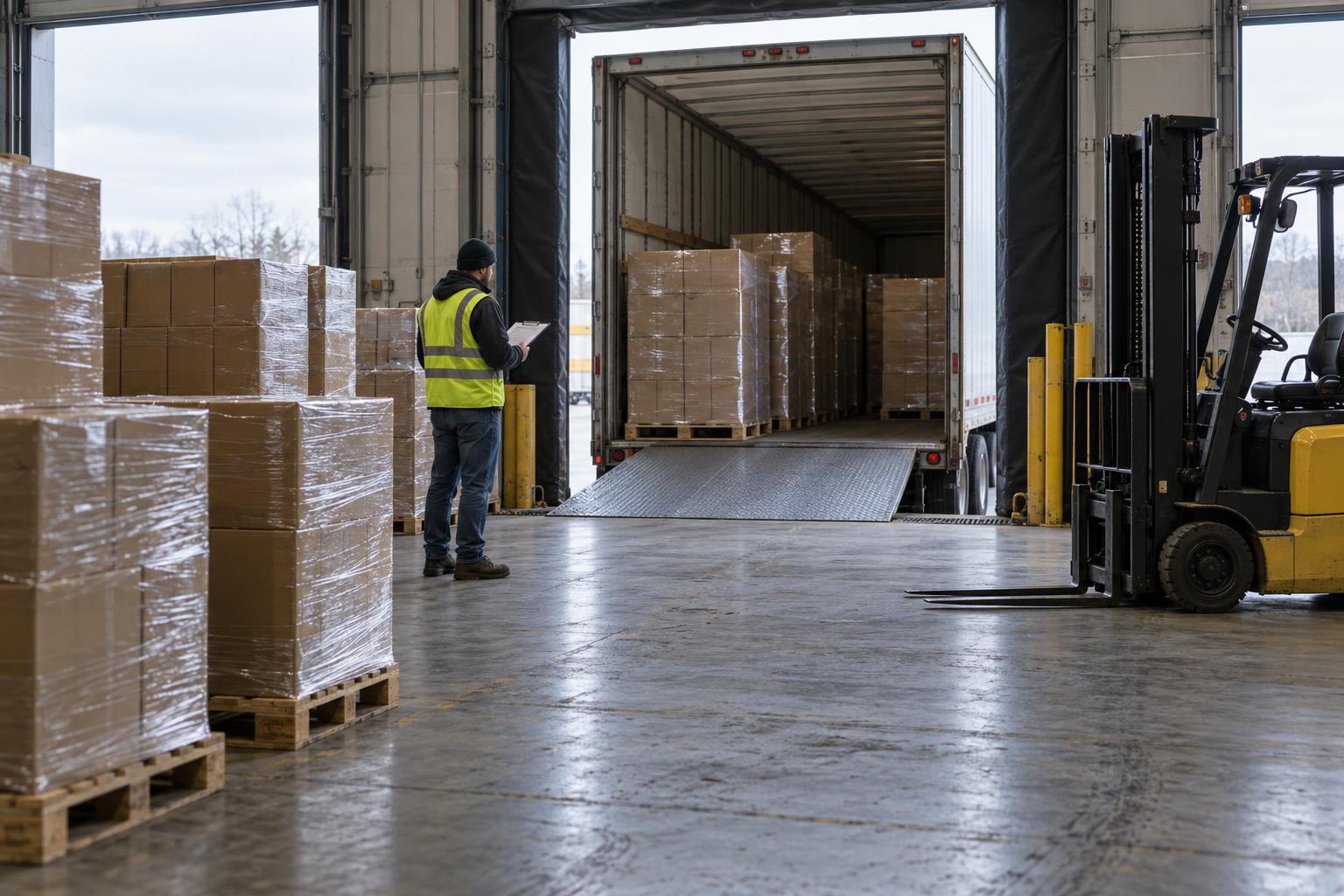
Once the shipment is delivered, the receiving clock is not the same as the transit clock. Plan 4 to 10 days between delivery and units showing as available, and longer in October and November. Track three things in the first week.
The shipment status in Seller Central, which moves from delivered to receiving to closed. Discrepancies against the carton count on the bill of lading. And the reimbursement clock, which does not start until the shipment reaches closed status.
Missing cartons are recovered with paperwork, not with phone calls. Keep the proof of delivery, the appointment record, the carton level packing list, and photos of every sealed carton from the factory. Without the photos, a shortage claim is your word against a receiving scan.
What one shipment actually costs
Here is a 500 unit order of one SKU, 20 cartons, 12 kg per carton, moving LCL from Shenzhen to a West Coast fulfillment center. Figures are rounded to the dollar. The duty rate is a placeholder, because the real number depends on your HTS code.
| Line | Basis | Amount | Per unit |
|---|---|---|---|
| Goods | $6.20 per unit, FOB | $3,100 | $6.20 |
| Factory prep and labeling | $0.35 per unit | $175 | $0.35 |
| Ocean LCL, origin to door | 1 CBM minimum, all in | $190 | $0.38 |
| Duty | 25 percent of goods value | $775 | $1.55 |
| Merchandise processing fee | 0.3464 percent, minimum applies | $33 | $0.07 |
| Terminal, drayage, appointment | Flat per container | $185 | $0.37 |
| Placement fee | Zero, if 5 identical cartons per item | $0 | $0 |
| Landed cost | $4,458 | $8.92 |
Landed cost is 44 percent above the FOB price. Put that number in your pricing sheet, because the forwarder quote covers one line out of the eight.
The merchandise processing fee in that table is CBP's charge for handling the entry: 0.3464 percent of value, with a minimum and a maximum that CBP resets each fiscal year.
Figure basis: No line in this table is a client invoice. The freight lines are this quarter's quote range, the duty is the 25 percent assumption stated above, and your own HTS code will move that line more than any freight negotiation will.
Two lines move this total more than freight does, and both are fixed before the container leaves China. Duty follows the HTS code. The placement fee follows the carton count.
Six failures that cost the most
| Failure | What it costs | Prevention |
|---|---|---|
| Covered or wrinkled FNSKU | Units unsellable, or the whole carton refused | Photo of a labeled unit with the barcode scanned at 20 feet |
| Carton over 50 lb or over 36 in | Refused at the dock, returned at your expense | Weigh and measure three cartons per run, not one |
| No delivery appointment | Detention at $150 to $300 a day | Confirm the appointment number with the carrier, in writing |
| Wrong HTS on the entry | CBP hold, post-entry correction, penalties in bad cases | Supplier HTS in writing, broker confirms before PO |
| Split below the placement threshold | Per unit fee on the entire shipment | Count identical cartons per item before creating the plan |
| No photos of sealed cartons | Shortage claim denied | Photo every carton face, plus the sealed pallet, before pickup |
How to choose a forwarder
Ask these ten before you sign. Questions 1, 2 and 7 are the ones a weak forwarder talks around.
- Do you act as importer of record, and under whose bond?
- What is your US customs bond number and who is the broker of record?
- Will you show me the duty breakdown by HTS, or only a total?
- Which fulfillment centers do you deliver to directly, and which go through a partner?
- What is your appointment booking lead time at ONT8 in November?
- What happens if Amazon rejects the cartons, and who pays the return?
- Do you charge detention at cost or with a markup, and can I see the carrier invoice?
- Who handles a shortage claim, and how many have you filed this year?
- What is your cut-off for a booking that still makes this week's vessel?
- Can I see a recent bill of lading for a shipment of similar size, with the commercial data redacted?
Two red flags are worth walking away from. A quote that is dramatically below the market on a DDP rate, because the difference is usually declaration value. And a forwarder who cannot name the broker, because that means the entry is going through a third party they do not control.
When it goes wrong
The first 48 hours decide whether a rejection costs you a relabel or a returned container. Work in this order.
Stop the clock on anything still moving. If the container has not been delivered, hold it. Fixing a carton in a 3PL near the port costs a fraction of fixing it after a rejection.
Collect the four documents before you talk to anyone. Proof of delivery with the appointment number, the carton level packing list, the photos from the factory, and the receiving scan from Seller Central.
Match the box IDs, not the counts. Amazon reconciles by FBA box ID. A shortage that looks like four missing cartons is often four cartons logged under the wrong shipment.
File inside the window. Amazon sets the filing windows in its FBA inventory reimbursement policy, and the clock runs from when the shipment closes, not from when the truck arrived. Sellers who wait for the receiving team to finish investigating usually file late.
FAQ
How long does it take from factory to FBA? Ocean plus receiving is 32 to 48 days door to available. Air is 12 to 24. Add a week for factory prep and a week for booking if the order is not already in production.
Do I need a US company to ship into FBA? Not a US one, no. You need an importer of record with a bond. Some sellers use their own foreign entity, and some appoint a forwarder under DDP. The first gives you control of the duty and a drawback claim, the second is faster to set up.
Can Amazon be my importer of record? Never. Amazon states plainly that it will not act as IOR. A shipment arriving without a valid IOR stays at the port.
Is DDP required? Not required. DDP is a commercial term, not a rule. Amazon requires that duty is paid and that Amazon is not the IOR. How you achieve that is your choice.
What is the carton size limit in 2026? 36 by 25 by 25 inches and 50 lb for FBA. AWD still caps at 25 inches on every side. The 36 inch length limit has applied since 20 June 2025.
Can I mix SKUs in one carton? Only when the shipment plan expects it, and it complicates the placement fee calculation. Unless the plan says otherwise, one SKU per carton, clearly labeled.
Sources
Every third-party figure in this guide is sourced from the documents listed below. Each one is also declared in small print, with the publisher and the document reference, directly under the paragraph or table it supports, so the claim and its origin appear in the same place. All links were opened on 22 October 2026. Amazon revises its help pages without notice, so treat that date as the shelf life of any claim in this article.
| Document | Issued by | Reference |
|---|---|---|
| FBA prep and item labeling service↗ | Amazon Seller Central | G201023020, service ended 1 January 2026 |
| FBA shipment requirements↗ | Amazon Seller Central | G200141510, carton size, weight and labeling |
| Inbound placement service fee↗ | Amazon Seller Central | GC3Q44PBK8BXQW3Z, five identical carton threshold |
| FBA inventory reimbursement policy↗ | Amazon Seller Central | G200213130, claim filing windows |
| Amazon Warehousing and Distribution↗ | Amazon Seller Central | G201021850, intake and pallet rules |
| Meltable FBA inventory↗ | Amazon Seller Central | G202125070, seasonal acceptance window |
| Dangerous goods documentation↗ | Amazon Seller Central | 201371860, hazmat review and UN 38.3 |
| Filing a formal entry↗ | US Customs and Border Protection | Article 1073, 10 day entry summary window |
| Customs bonds↗ | Electronic Code of Federal Regulations | 19 CFR Part 113 |
| Section 301 tariff actions↗ | Office of the US Trade Representative | Section 301 lists and additional rates |
| Harmonized Tariff Schedule↗ | US International Trade Commission | Duty rate by HTS code |
| De minimis collection announcement↗ | CBP newsroom | China 2 May 2025, global 29 August 2025 |
| Import basics↗ | CBP trade portal | Entry types and importer obligations |
| Detention and demurrage billing↗ | Federal Maritime Commission | 46 CFR Part 541, 30 day invoice rule |
Written by the shipping desk in our Shenzhen office. The rules above were checked on 22 October 2026. The landed cost table is a worked illustration, not a quotation, and the freight ranges are this quarter's quotes rather than a rate card.